
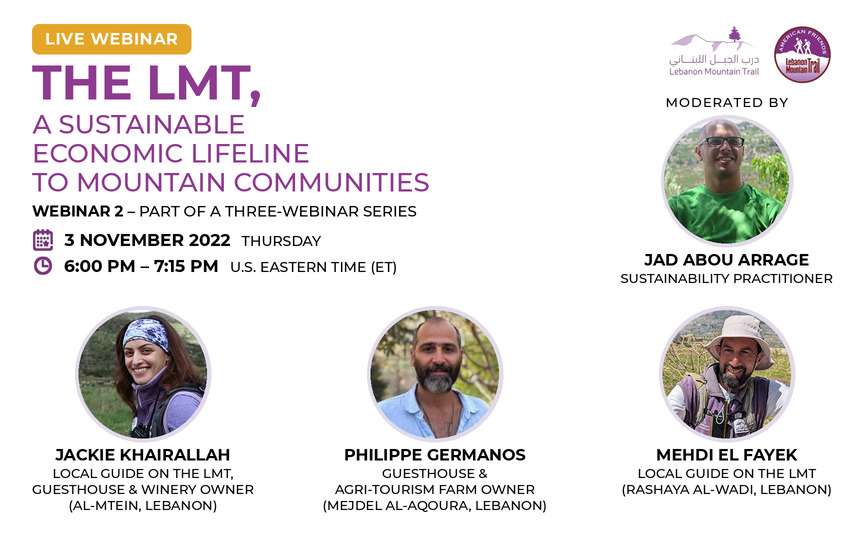
The second webinar in AFLMT’s series looked at what the Lebanon Mountain Trail means for the communities along its route. Moderated by sustainability practitioner Jad Abou Arrage, the session brought together three people whose lives and livelihoods have become intertwined with the trail: a guide and winery owner in Mtein, a guide and guesthouse host in Rachaya, and a farmer who turned his family’s land in Aqoura into an agrotourism destination.
Webinar 2 of 2 in AFLMT’s series on the Lebanon Mountain Trail
The LMT, an Economic Lifeline: How the trail keeps mountain villages alive
A local guide, a winery owner, and a farmer described how the Lebanon Mountain Trail brought visitors to their villages, created new sources of income, and gave them and their family a reason to stay.
- Held
- November 2022
- Moderator
- Jad Abou Arrage
- Panelists
- Jackie Khairallah, Mehdi El Fayek, Philippe Germanos
Mtein: From one guesthouse to many
Jackie Khairallah is a local guide on the LMT, a winery and guesthouse owner, and a mother of four in Mtein.
“The LMT changed my life; it opened a new vision for me. Guiding on the LMT opened many doors and gave me economic opportunities that I did not have before.”
Jackie Khairallah, local guide and winery owner, Mtein
Hikers passing through Mtein grew curious about her family’s winery. That led to hosting visitors for meals and wine tastings, and then to two wooden chalets she and her husband built for overnight guests. When she started guiding, every visitor to the winery was an LMT hiker, and hikers still account for about 60 percent of the business.
The change reaches beyond her family. Mtein once had a single guesthouse, established by the LMT project. Today it has more than four, including her wooden chalets.
- Winery business from LMT hikers
- About 60 percent
- Guesthouses in Mtein
- From 1 to more than 4
Rachaya: A reason to stay
Mehdi El Fayek has always loved showing visitors around Rachaya. When the LMT project brought the trail through his village and opened a guesthouse there around 2006-2007, Rachaya became a destination, which encouraged Mahdi to and the trust people placed in the project extended to him as a guide and host. In 2014 he opened his own guesthouse in 2014.
“My family now earns a living in three ways: guiding, hosting guests, and making and selling local produce. Thanks to the LMT, I now guide groups on the LMT or up Mount Hermon once or twice a week, and that steady work helped me stay in my village instead of thinking about leaving the country.”
Mehdi El Fayek, local guide and guesthouse owner, Rachaya
“LMTA is a trusted organization, a recognized brand in our region. That is important. It gives us credibility,” added Mehdi.
- Groups guided
- From 1 a month to 1 or 2 a week
- Family income sources
- Guiding, hosting, local produce
Aqoura: A cottage house and a farm become a destination
Philippe Germanos returned home to Aqoura to look after his family’s farm. He then met Christian Akhrass, LMTA Field Coordinator, who was looking for a place for hikers to stay near Afqa, 10 minutes away. The next morning Philippe called back to say his house in the mountains was now a guesthouse and the LMT was welcome to use it. Two months later his first guests arrived: two American hikers walking the trail.
He has since combined the farm and guesthouse into a single agrotourism project, now in its seventh year. About 30 percent of his visitors come for hiking on the LMT or in the surrounding region.
“Seven years ago, no one in the village knew what hiking was.”
Philippe Germanos, guesthouse and agrotourism farm owner, Aqoura
Awareness of ecotourism, hiking, and nature has grown since then, Philippe said, though it hasn’t reached its full potential yet. He credits the LMT and LMTA as the driving force behind this remarkable transformation: the region now has more guides, more places to stay, and more hikers and visitors every year.
- Visitors
- 30 percent come as part of a hiking experience
- First guests
- Two American LMT hikers